Vertical Pipetting Station User Guide : Safety guidelines : Potential safety hazards

Potential safety hazards
About this topic
This topic describes potential hazards that you can encounter when using the Vertical Pipetting Station.
Mechanical hazards
Safety shield
 
WARNING Operating the Vertical Pipetting Station without a safety shield or enclosure cover increases the risk of injury.
You should enclose the Vertical Pipetting Station in a safety shield or enclosure to restrict access to the Vertical Pipetting Station while it is operating. For example, you can connect a light curtain to the Vertical Pipetting Station robot-disable circuit.
Moving parts
 
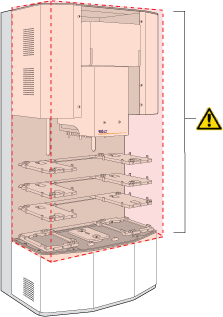
WARNING  When you initialize the Vertical Pipetting Station, the pipette head and shelves can move.
 
WARNING  Keep clear of the pipette head while it is in motion. Do not touch any of the moving parts or attempt to move labware while the Vertical Pipetting Station is in operation. The device could pinch, pierce, or bruise you. For example, a pipette tip could pierce your hand.
Figure. Vertical Pipetting Station with shaded areas showing pinch point hazards
 
The Vertical Pipetting Station has moving parts that can injure you if you deviate from the procedures given in this guide. It is the responsibility of every operator to follow safety precautions and keep away from the Vertical Pipetting Station whenever it is likely to move.
 
 
Hazardous-voltage electronics
Hazardous-voltage electronics can be found within the Vertical Pipetting Station. Under normal operating conditions, you are protected from exposure to the hazardous voltage.
 
 
WARNING  Do not try to gain access to the interior of the Vertical Pipetting Station. Do not remove panels for any reason. Exposure to the interior electronics of a device can cause severe injury.
 
Hazardous-voltage electronics can also be found in the computer. See the computer manufacturer documentation for the hazard warnings. Make sure you follow the instructions on the safe operation of the computer.


High-pressure gas
Compressed air is used to move components inside the Vertical Pipetting Station.
 
Follow the local, state, and federal safety codes for the placement and mounting of gas cylinders. For example, you might have to attach a standard cylinder bracket to a solid permanent structure to meet or exceed all local seismic and safety requirements.
Always use good laboratory practices when handling high-pressure cylinders. Make sure you follow any instructions provided with the cylinders.


Chemical hazards
General guidelines
Some chemicals used when working with the Vertical Pipetting Station can be hazardous. Make sure you:
Compatible chemicals
The Vertical Pipetting Station surfaces are designed to be compatible with small volumes of aqueous solutions, common biological buffers, solvents, and common reducing agents.
The following chemicals were tested for brief exposures outside the liquid-handling channels:
Strong base (HPO4 or sodium hydroxide, 100 mM) pH 12-13
Agilent Technologies recommends that you employ an Environmental Health and Safety professional on site to confirm the compatibility of other chemicals.
 
 
Moving the Vertical Pipetting Station
Before moving a Vertical Pipetting Station, see Laboratory requirements for information on selecting the new location.
 
WARNING The Vertical Pipetting Station weighs 37.195 kg (82 lb). Do not attempt to move the Vertical Pipetting Station without assistance. Use proper lifting techniques when lifting the Vertical Pipetting Station.
 
CAUTION Agilent Technologies is not responsible for damage if the Vertical Pipetting Station is incorrectly packaged and moved by someone other than an Agilent Technologies employee.
Related topics
 
Stopping the Vertical Pipetting Station in an emergency
Reporting problems with the Vertical Pipetting Station